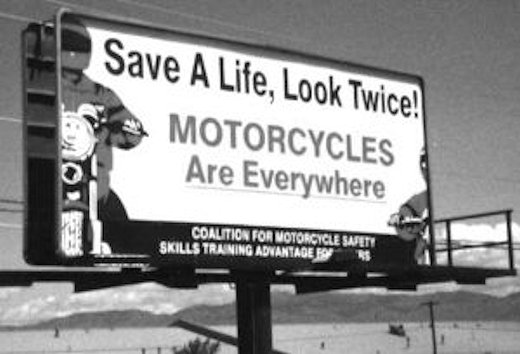
Motorcycle Awareness Billboards

November 2006

Distracting Drivers … So They’ll Pay Attention?

Figures don’t lie, but liars figure. Nowhere is that old saying more applicable than to politics in general and motorcycling issues in particular. Few will argue, however, with the fact that consistently over the 10-year period from 1995 to 2004 about 90% of all U.S. motorcycle fatalities occurred on roads that are not divided or have no median barrier.

Why? Because that is where motorcyclists are most vulnerable to crashes (both single- and multi-vehicle) caused by right-of-way violations resulting from the negligence and inattentional blindness of distracted and impaired automobile drivers. And what can we do about it? Reduce the number of distracted and impaired drivers on the road. And how do we do that? By identifying the sources of driver distraction and impairment, and eliminating to the extent feasible those for which it is socially cost-effective, and not just politically expedient, to do so.

We already have DUI and vehicular homicide laws on the books to deter and punish drivers impaired by alcohol. And now, we have scientific evidence that drivers engaging in cell phone conversations (including those using hands-free devices) are just as impaired as someone with a .08 blood alcohol level, and consequently 4 times as likely to cause or be involved in a crash as unimpaired drivers.

Educate, Don’t Legislate does not apply to impairment, so it would be logically and ethically consistent to extend our DUI laws to cover the new DWI: Driving While Inattentive. In all fairness, and to avoid hypocrisy, we need to either…

BAN THE CALLS … OR FREE THE DRUNKS

Madd Ray Henke offers much more on this topic here: http://tinyurl.com/o9bzh

Banning cell phone conversations while driving will mitigate a major proven distraction. Another distractor we need to take a long hard look at (pardon the pun) is ROADSIDE BILLBOARDS.

According to a study by the Center for Crash Causation and Human Factors at Virginia Tech’s Transportation Institute (VTTI), “… billboards do not measurably affect driving performance:”

http://tinyurl.com/f9ju6

But that study is tainted by the fact that it was commissioned by the Foundation for Outdoor Advertising Research and Education (FOARE), which is administered by the Outdoor Advertising Association of America, Inc. (OAAA), which is the lead trade association representing the outdoor advertising industry. Wikipedia puts it this way:

“Traffic safety experts have studied the relationship between outdoor advertising and traffic accidents since the 1950s, finding no authoritative or scientific evidence that billboards are linked to traffic accidents. However, many of these studies were funded by the Outdoor Advertising Association of America, which has led to accusations of bias. The methodology used in certain studies is also questionable.”

Could it be that Big Advertising, like Big Tobacco, would much rather knock off some of their customers than kill a cash cow? A more objective and credible study is available here:

http://tinyurl.com/qtznf

According to this study, entitled “External-To-Vehicle Driver Distraction” and commissioned by the Scottish Executive (the government of Scotland), “The evidence suggests that there are two specific situations where the risk factor of billboards and signs is at its highest:

at junctions [intersections], and

on long monotonous roads (such as motorways [interstates]).

There is overwhelming evidence that advertisements and signs placed near junctions can function as distractors, and that this constitutes a major threat to road safety. This is because these signs create visual ‘clutter’ thus making it harder for the driver to perceive traffic lights and other safety signs/devices. It is also likely that drivers can become distracted by lights or billboards on long ‘boring’ stretches of road. This may be because they are ‘caught by surprise’ when advertisements suddenly appear, or because they fixate on them and fail to concentrate on driving.” Wikipedia adds the following:

“[Studies] based on correlations between traffic accidents and billboards face the problem of under-reporting: drivers are unwilling to admit responsibility for a crash, so will not admit to being distracted at a crucial moment. Even given this limitation, some studies have found higher crash rates in the vicinity of advertising using variable message signs or electronic billboards.”

As I said earlier, figures don’t lie, but liars figure. Depending on whose research you choose to believe, roadside billboards may (or may not) be a major driver distraction. My personal observations and experience suggest they are. And IF they are, I think billboards are the last medium we’d want to use to convey our MSAP Motorcycle Awareness messages. After all…

WHY WOULD WE WANT TO DISTRACT DRIVERS, JUST TO TELL THEM TO PAY ATTENTION TO THEIR DRIVING?

Until Next Time … Ride Long, Ride Free!

NTSB Position Paper

October 2006

Submitted to the NTSB Public Forum on Motorcycle Safety:

September 2, 2006

Ms. Deborah A.P. Hersman
Forum Chairman
National Transportation Safety Board
Public Forum on Motorcycle Safety
NTSB Board Room and Conference Center
429 L’Enfant Plaza
Washington, D.C. 20024

Dear Ms. Hersman:

Your stated goal for the NTSB Public Forum on Motorcycle Safety (“NTSB Forum”) scheduled for September 12-13, 2006 is “… to gather information about ongoing motorcycle safety research and initiatives, as well as safety countermeasures that may reduce the likelihood of motorcycle accidents and fatalities.” This statement suggests a serious misunderstanding of the greatest single problem in the motorcycle safety arena, as well as a discriminatorily skewed vision of where and how to approach a solution.

“Countermeasures?” What happened to measures? Do you seriously expect to devise a winning strategy based solely on defense? What happened to offense? The most serious threat facing American motorcyclists today is a killer that can only be overcome by aggressive proactivity, not feeble reaction. That killer is the negligence, distraction and inattentional blindness of automobile drivers. Quoting Motorcycle-Accidents-Lawyers-Attorneys.com:

“Approximately three-fourths of all motorcycle accidents involve another motor vehicle. Two-thirds of these accidents were caused by the motorist failing to yield the right of way. The most common reason given by the motorist involved in these accidents is that they ‘didn’t see’ the motorcycle. These types of accidents account for approximately 50 percent of ALL motorcycle accidents! Recent scientific studies focusing on a phenomenon known as ‘inattentional blindness’ may help us understand why car drivers often end up causing accidents with motorcycles they ‘didn’t see.'”

If you are interested in trends in safety statistics, here is one that NHTSA shows as remaining constant for ten years: About 90% of all motorcycle fatalities occur on roads that are NOT DIVIDED or have NO MEDIAN BARRIER (as opposed to exit/entry ramps, one-way streets, or roads with median barriers). Combining this with the above yields the following:

90% of all motorcycle fatalities occur on undivided roads, where automobile drivers can most easily violate the right-of-way of motorcyclists.

75% of all motorcycle accidents involve another motor vehicle.

66% of all multi-vehicular motorcycle accidents are caused by motorists failing to yield the right-of-way to motorcycles.

50% of all motorcycle accidents are caused by the inattentional blindness of automobile drivers.

As previously stated, and as the foregoing and other statistics support, the greatest single problem in the motorcycle safety arena today is the negligence, distraction and inattentional blindness of automobile drivers. If it is truly the goal of the NTSB Forum to “…reduce the likelihood of motorcycle accidents and fatalities,” then this should be the focus of the forum and the first and foremost issue to be addressed. From that perspective, let’s evaluate your published panel agenda:

Trends and Safety Statistics
Vehicle Design (Part 1)
Vehicle Design (Part 2)
Rider Protective Equipment
Training and Licensing
Public Education/Awareness
Rider Impairment
Future Directions

Where is the session on “Mitigating Inattentional Blindness”? Where is the session on “Eliminating Cell Phones as a Source of Driver Distraction”? Where is the session on “Severe and Specific Penalties for Right-of-Way Violations”? Where is the session on “Mandating Motorcycle Awareness Training and Drivers License Testing”? And why look at “Rider Impairment” rather than “Motorist Impairment”?

As does its stated goal, the published panel agenda for the NTSB Forum suggests a serious misunderstanding of the greatest single problem in the motorcycle safety arena, as well as a discriminatorily skewed vision of where and how to approach a solution. The primary directive of any motorcycle safety initiative should be to reduce the probability of a motorcyclist being involved in an accident, i.e., crash prevention. The objective should be to develop and apply remedies which mitigate the major causal factors. Your published panel agenda suggests a near complete abrogation of this directive, as if you are conceding the probability of crash occurrence and focusing merely on crash survival:

If motorcycle accidents are a sickness, then your agenda treats the symptoms rather than the disease. If the NTSB were charged with treating a gunshot wound, would you remove the bullet, or just put a band-aid over the hole?

If motorcycle accidents are a crime, then your agenda blames the victim. If the NTSB were charged with reducing the number of people shot in downtown Detroit, would you round up the shooters, or simply mandate Kevlar vests?

America may be democratically governed, but it is celebrity driven. Every day, hard-working tax-paying citizens riding motorcycles are maimed and killed by inattentive and negligent automobile drivers, while calls for increased measures to mitigate inattentional blindness go unheeded. But let that injured rider be a star football player, and everything changes: The media reports he wasn’t wearing a helmet–as if wearing a helmet would have prevented the guilty driver from turning in front of him–fueling a public frenzy that compels politicians and bureaucrats alike to act or risk losing position and paycheck.

Despite your statement to the contrary, many believe that the NTSB Forum was triggered by the recent accident involving Pittsburgh Steelers quarterback Ben Roethlisberger … and no one will be surprised if at your forum the helmet law issue takes center stage. And more’s the pity:

Over the years, an appalling amount of time, money and energy has been wasted by parties on both sides of the helmet law debate. On one side, we have biker advocates who have difficulty differentiating safety factors from rights issues, and who consequently and erroneously assail the effectiveness of helmets rather than the (in)equity of the laws mandating their use. To these well-meaning but ill-advised activists, I offer the following challenge:

I will tie you in a chair, then stand in front of you with a 22-ounce framing hammer in one hand, and a helmet in the other. Before I bring the hammer down claws first, aimed squarely at your coronal suture, I will offer you the helmet. If you accept the helmet, I expect you to go home and never spew anti-helmet hogwash again. If you don’t accept the helmet, I’ll make certain your conviction to your beliefs is noted in your eulogy.

One the other side, we have expedience-minded politicos, profit-seeking charlatans and a myopic media trying to convince the populace that helmets and helmet laws are the motorcycle safety cure-all, when in fact neither wearing a helmet nor mandatory helmet laws do anything to prevent motorcycle accidents. To this quick-blame, quick-fix, quick-buck consortium I ask the following questions:

If Big Ben had been wearing a helmet, would that have prevented the negligent driver of the car he hit from turning in front of him? When has the wearing of a helmet by a motorcyclist ever kept a weaving SUV driven by a soccer mom on a cell phone from running the biker off the road? And how often has a mandatory helmet law deterred a distracted driver from plowing through a motorcyclist waiting for a light change?

Specious helmet arguments and ceaseless helmet law debates drain us of precious resources better spent on motorcycle awareness … better spent on addressing the fact that two-thirds of all multi-vehicle motorcycle accidents are caused by the negligence, distraction and inattentional blindness of automobile drivers.

Helmets may save lives, but focusing on crash survival (by mandating helmets for motorcyclists only), rather than crash prevention (through severe, specific right-of-way violation penalties, restricting the use of cell phones while driving, mandatory driver education and testing, and motorcycle awareness programs to mitigate inattentional blindness), is not only an ineffective public policy and a waste of public resources, but also blatantly discriminatory.

Few rational people will argue that in most situations a helmet offers some degree of protection to the head it covers. And since ALL Americans are entitled to equal protection under the law, a case could be made for mandating helmets for ALL motor vehicle operators and passengers. That line of reasoning might easily be extended to include bicyclists and pedestrians, and from there it is a short leap to the addition of boxers, bladers, boaters, bathers and babies.

There can be no logical argument to the assertion that the best way to reduce the probability of motorcycle injuries and fatalities is to reduce the probability of motorcycle accidents. But even a sweeping reversal of years of discrimination against motorcyclists by mandating a helmet for the head of every man, woman and child in America would have no impact on that statistic.

In 25 words or less, the position this paper is intended to convey is this:

Helmets and other defensive measures cannot prevent or lower the probability of motorcycle accidents. Proactive ABATEment of negligent, distracted, impaired and inattentive motorists can.

Speaking strictly for myself and no other individuals or organizations,

Bruce Arnold aka IronBoltBruce

Bruce@LdrLongDistanceRider.com
Author and Publisher, LdrLongDistanceRider.com
Co-Moderator, Bruce-n-Ray’s Biker Forum
Premiere Member, Iron Butt Association
Sustaining Member, Motorcycle Riders Foundation
Member and Elite Legislative Supporter, American Motorcyclist Association

Live to Tow … Tow to Live

September 2006

Trailers May Succeed Where Helmets Fail

The 66th Annual Sturgis Motorcycle Rally is just a fond memory for me now … as is the positive bank balance I had before attending it. It’s another rainy Sunday here in South Florida, so with no sun and no mon’ to have any fun, I decided to take another look at NHTSA’s June 2006 DOT HS 810 606 Technical Report:

Recent Trends in Fatal Motorcycle Crashes: An Update

If NHTSA’s thinking was that valuable conclusions regarding motorcycle safety could be drawn from isolating and analyzing motorcycle crash fatality statistics, then this entire report is based on a faulty premise. And no, I’m not talking about the problems with their vehicle miles traveled (“VMT”) data. What I’m referring to is the lack of a complete statistical context. Where, for example, are the numbers on non-fatal crashes, and non-fatal injuries? In analyzing how any given factor impacts the overall safety of a motorcycle rider, a complete statistical context would tell us whether:

(a) it increased or decreased the probability of a crash;

(b) in case of a crash, it increased or decreased the probability of injury;

(c) in case of injury, it increased or decreased the probability of recovery; and

(d) in case of non-recoverable injury, it increased or decreased the probability of fatality.

Yes, in a perfect world, these are the kinds of statistics we’d be getting from NHTSA. But the world ain’t perfect (and neither is NHTSA). Consequently, the section of this report intended to show the relationship of motorcycle rider helmet usage to crash survivability is lacking in context and provides no basis for reliable conclusions. And even if it did, the numbers offer just enough ambiguity to encourage parties on both sides of the helmet law issue to continue their specious debates.

Nevertheless, crunching the numbers contained in this report did support some of their conclusions and lead to some interesting observations. One is that motorcycling in America is undergoing what sociologists call a paradigm shift, and it wasn’t in the direction that I expected. Graying Baby Boomer Bikers are not being supplanted by Gen X Crotch Rocketeers. Instead, between 1998 and 2003:

(a) the number of registered motorcycles in the U.S. increased from 3.9 to 5.4 million;

(b) the percentage of motorcycle owners aged 40 and over increased from 43 to 53, a gain of 23%; and

(c) the 40-plus percentage share of crash fatalities increased from 33 to 46, a gain of 39%.
The trend indicated is that the number of motorcycles on the road is increasing … the proportion of those bikes owned by older riders is increasing … and the percentage of those older riders able to avoid fatal accidents is decreasing.

Unless you just landed on Earth or awoke from a long coma, this is probably not a mind-blowing revelation for you. The challenge to all of our collective neurons, however, is what to do about the problem. The perennial solution offered up by NHTSA, the American Automobile Association, the Heads Up Coalition and other cager-centric collaborations is, of course, mandatory helmet laws. But should we really expect lid laws to make a difference? Both logic and NHTSA’s own numbers tell us the answer is NO. Let’s break it down point by point:

Do mandatory helmet laws reduce the number of motorcycles on the road?

You bet they do, as is evidenced by the increase in motorcycle sales each time a state is liberated from its lid law. But can they reduce them enough to significantly decrease the number of fatalities among 40-plus riders nationwide? I’d say NO, they can’t.

Do mandatory helmet laws reduce the proportion of bikes owned by older riders?

I have no statistics relevant to this question, but logic and observation suggest that lid laws have no significant impact on motorcycle ownership by age.

Do mandatory helmet laws increase the percentage of older riders able to avoid fatal accidents?

NHTSA’s numbers suggest that helmeted riders are more likely to be involved in a fatal accident, but those numbers may be more reflective of the state where the accident occurred (free state vs. lid state) than anything else. The reality is that we have no reliable statistics suggesting any correlation–positive or negative–between helmet usage and crash fatalities.

Biker Patches: Towaposa TribeHelmets are not now, and never will be, the silver bullets of motorcycle safety. But where helmets fail, trailers may succeed. Especially with the 40-plus age group, where the greatest increase in motorcycle crash fatalities seems to be occurring. Again, let’s break it down point by point:

Do trailers reduce the number of motorcycles on the road?

Of course they do! Every motorcycle towed is one less bike on the road.

Do trailers reduce the proportion of bikes owned by older riders?

Who cares? If the bike is being trailered, there is an extremely high probability there will be no rider in the saddle. And regardless of age, if there’s no rider, there can be no motorcycle fatality!

Do trailers increase the percentage of older riders able to avoid fatal motorcycle accidents?

Absolutely. I can think of no more reliable way for older riders to avoid fatal motorcycle accidents than to have their bikes towed rather than rode!

Wake up, people. It’s only a matter of time before NHTSA, the AAA and all of the ACS Trauma Surgeons figure out that trailers can save a lot more lives than helmets ever could. So unless the American Motorcyclist Association steps up to the plate and starts swinging, get ready for a new biker t-shirt slogan:

LIVE TO TOW … TOW TO LIVE

Fight Smarter … Not Harder

August 2006

Riding and Racing Mean Nothing Without Rights

Even before the Big Ben Incident and the veto of Michigan’s helmet law repeal, the number of media-sponsored online polls regarding helmet laws and other motorcycle issues was steadily increasing. You can expect that trend to continue, but don’t think for a moment that the media’s motivation is to inspire democratic debate or express altruistic concern for the greater good. It’s not about the cause, my brothers and sisters, it’s about the cash.

Television producers give us free infotainment programming because advertisers pay them big bucks to run their ads during commercial breaks. How big those bucks are depends on how many viewers those shows get (which is what the Neilsen ratings are all about). A similar business model is maturing on the Web: Most TV, radio, newspaper, magazine and other media operations offer free access to some or all of their online content, and sell ad space on their web pages to generate revenues. How much they can charge for those ads is a function of how many visitors they can attract to their site.

When a talking head at KRAP TV invites you to log onto their website to participate in a motorcycle safety survey, or a DJ at KRUD FM tells you to surf on over to their opinion poll page and vote on a proposed helmet law, understand that what they are really doing is herding sheeple to their website to increase visitor counts and profit potential. YOU ARE BEING USED. But don’t let that bother you too much. After all, they are providing you with free information and entertainment, and everybody’s gotta make a living, right? Besides, it is important that our votes be counted and voices be heard in all motorcycle-related online polls and surveys. Why? Because if the vote goes against us, rest assured that the results will come back to bite us. If we flip the script, however, we turn that potential liability into a political asset.

So whenever you get the call to vote for our interests in some online poll or survey, please click through as soon as you can. BUT, don’t sit there and click away once you do. Every time I read some email or posting where someone boasts about clicking YES or NO hundreds or thousands of times in order to turn the tide of some poll, I cringe at the waste of effort. Why is that a waste? Because most–not all, but most–website survey and poll software can easily detect and block or delete duplicate votes. All they need to do is assign a cookie to your session, or monitor your IP address. It may appear that your repeated clicks are changing the numbers, but it is likely that any changes you see are coming from activity elsewhere, and that in the end your redundancies will be deleted from the tally.

FIGHT SMARTER … NOT HARDER. If you’re going to work up a good case of carpal tunnel syndrome anyway, why not make it count for something?!? Log onto the online survey or poll page, and place your vote. Once. Then email the survey link (web page address or URL) to every biker-friendly address in your Contacts list, asking them to not only go there and vote, but also to forward your call-to-action to every biker in their Contacts list. Next, email your call to every state, regional and local officer and director of your SMRO, asking them to do the same thing. Then, there are four very special people to whom you should email your call-to-action:

Dal Smilie (dsmilie@mt.gov)
Chairman of the Board, American Motorcyclist Association

Robert Rasor (rrasor@ama-cycle.org)
President, American Motorcyclist Association

Ed Moreland (emoreland@ama-cycle.org)
VP for Government Relations, American Motorcyclist Association

Terry Lee Cook (tcook@ama-cycle.org)
Grassroots Manager, American Motorcyclist Association

RIGHTS. RIDING. RACING. The American Motorcyclist Association (“AMA”) is certainly the largest and potentially the most influential motorcyclists’ rights organization in the country. Here is a quote from page 59 of the July 2006 issue of AMA’s American Motorcyclist magazine:

“When our government relations staff members sit down to talk to the sponsor of some anti-motorcycling bill, they can casually point out that they’re speaking for 273,000 enthusiasts who care very much about this issue. And that makes a big difference.”

Perhaps that last sentence should read “And that could make a big difference.” Why do I say that? Because the AMA didn’t do much to check the flood of misdirected media spin from the Big Ben Incident … and if they’re doing anything at all to counter the American Automobile Association’s aggressive helmet law lobby–that recently won in Michigan and is threatening to reinstate lid laws in Pennsylvania and elsewhere–I haven’t seen much evidence of it.

The AMA says they are in favor of voluntary helmet usage and consequently oppose mandatory helmet laws. The fact that the statistics in their official helmet usage position statement have not been updated since 2001, however, suggests that this issue may not be the ball that Dal Smilie and company are keeping their eyes on:

http://www.amadirectlink.com/legisltn/positions/helmet.asp

It might be that the AMA is merely giving lip service to the helmet law issue in order to keep membership dues rolling in from those of you who are concerned about bikers’ rights. If that is the case, then YOU ARE BEING USED. But note that I say “might,” so let’s find out the truth before we let it bother us too much. Here is one way to do that:

When you email your online survey call-to-action to Dal, Robert, Ed and Terry, explain to them why it is important that we prevail on the issue, and ask them to leverage their formidable political resources to assure that we do. Specifically, ask them to forward your call-to-action to all of their 273,000+ members. Granted, many of them won’t respond, but a small percentage of a large number is still a large number. And sure, they may not all live in the state where the issue is being raised … but AAA is crossing state lines, and so must we … and most online survey and poll software is NOT capable of filtering out-of-state “voters.”

If the AMA responds to your request, then we are almost certain to prevail on the poll or survey. If they do not, then don’t bother sending them a nasty email expressing your disappointment. If you do, they’ll probably just filter you out. Instead, when you get your next AMA dues reminder, break out your notepad instead of your checkbook … and let them know that RIDING and RACING mean nothing without RIGHTS.

Until Next Time … Ride Long, Ride Free!

Forget About Motorcycle Safety

July 2006

Forget about Motorcycle Safety?!? In order to understand why I say that, and to fully appreciate the rest of this article, I suggest you first acquaint yourself with the following:

MRO: A Strategic Framework

Mining Political Gold from Motorcycle Awareness Month
by Splatt

Motorcycle Awareness Efforts Must be Year-Round
by Madd Ray Henke

As I observed last month, “Motorcycle Safety” is a term best defined in context: Some see it as a cause, some sell it as a commodity, and many view it as an oxymoron. I include it as one of the four major arenas of my MRO Strategic Framework, but I also emphasize that the target of motorcycle safety initiatives should be motorcyclists, and not government or the public.

Motorcycle Safety is an Individual Responsibility

Motorcycle Safety is (or should be) about rider training and responsible riding. It is first and foremost an individual responsibility:

If you take a three-day motorcycle “crash” course, then go buy a 180-mph crotch rocket and ram your ass into a telephone poll on your first curve, whose fault is that?

If an uncontrolled skid rips off your surfer shorts, Oaxacan sandals and all the skin on your mangled arms and legs because you don’t ride the custom chopper you had trailered to Daytona enough to know how to slow down on a rain-slick road, whose fault is that?

If your drunken, helmetless head gets mushed into bloody oatmeal by the concrete wall you slammed into while speeding down a dark road after half a dozen body shots at your favorite strip joint, whose fault is that?
Your fault! That’s whose fault it is. Not NHTSA’s, the DMV’s or your MRO’s.

Motorcycle Safety is a Commodity

Many MROs that speak about Motorcycle Safety as a cause actually sell it as a commodity. I am okay with that so long as everything is above board, and the proceeds of the selling efforts are applied in the Motorcyclists’ Rights and Motorcycle Awareness arenas. I am not okay with that if the true underlying mission of the organization is simply to sell training and t-shirts, and rights and awareness issues receive nothing more than lip service.

Motorcycle Safety is a Travesty

50% of all motorcycle accidents are the result of inattentional blindness on the part of cagers. This is a Motorcycle Awareness issue, not a Motorcycle Safety issue. All the helmet laws, rider training and responsible riding in the world will not mitigate IB … yet we continue to allow the government to perpetuate a travesty, telling us the victim is responsible for the crime … as if there should be no penalty for shooting someone if they aren’t wearing a Kevlar vest!

Forget About Motorcycle Safety

We need to tell the state and federal government to forget about Motorcycle Safety. Motorcycle Safety is an individual responsibility, our responsibility, and we don’t need NHTSA or the DMV to tell us how to deal with it. The sooner we get this point across, the sooner the helmet law issue will cease to be an issue, and the sooner we can shift our political mode from defense to offense.

We must demand that May no longer be referred to as “Motorcycle Safety Awareness Month”. From now on, as Splatt and Madd Ray suggested, May should be referred to as “Motorcycle Awareness Month”, and all of the Mayors’ and Governors’ proclamations should be rewritten to focus not on putting riders in clown suits, but on getting the attention of the careless cagers who are killing us.

Politically, it is time we focus on Motorcycle Awareness … and forget about Motorcycle Safety.

Until Next Time … Ride Long, Ride Free!

MRO: A Strategic Framework

June 2006

Over the past several weeks, I have contributed to a flood of emails and forum postings on the subject of INATTENTIONAL BLINDNESS, the cause of 50% of all motorcycle accidents. I intend to say a lot more about “IB” in the future, but first I thought it might be helpful to show where it fits in the overall MRO strategic framework. And in order to do that, allow me to describe what I mean by a strategic framework for MROs (motorcyclists’ rights organizations) and other biker advocate groups:

MRO Strategic Framework

I believe that MROs should exist to promote the interests and protect the rights of motorcyclists. To accomplish this mission, their activities should be organized into four strategic arenas:

  • Member Acquisition and Retention
  • Motorcycle Safety
  • Motorcyclists’ Rights
  • Motorcycle Awareness

A high-level strategic framework identifying what I consider to be the primary objective, target audience, greatest challenge, best strategy and worst strategy for each of these four arenas is presented in the following paragraphs:

Member Acquisition and Retention

An MRO is a group of people representing a group of people. Members are what gives an MRO its reasons to exist and resources to operate. And like any political group in a democratic society, the broader the membership base, the more political muscle the group is likely to muster, and the greater the political impact the group is likely to have.

Through member acquisition and retention, an MRO gathers human and financial resources which it can deploy in the motorcycle safety, rights and awareness arenas. In order to do so, the MRO must “sell” its target audience–motorcyclists–on the benefits it can deliver in exchange for the time, money and other political capital they contribute.

When this selling effort fails or falls short of expectations, “rider apathy” is often cited as the cause of the problem. This is arguably a false diagnosis, however, in that the most likely cause of any failed selling effort is poor marketing strategy. For MROs, we believe that the best strategy for member acquisition and retention is to focus on key issues that appeal to the broadest possible demographic base. The worst strategy is to focus on a narrow demographic base, and concentrate on only those issues that appeal to them.

Food for thought: How do the demographics of your SMRO compare to the demographics of all motorcycle riders in your state? What percentage of your membership are white male Harley riders age 45 or older? What is that same percentage for all motorcycle riders statewide?

Motorcycle Safety

“Motorcycle safety” is a term best defined in context. Some see it as a cause, some sell it as a commodity, and many view it as an oxymoron. In the context of our strategic framework, “motorcycle safety” is our name for the arena in which MROs deploy resources aimed at saving lives and limbs through training, education and advocating responsible riding.

The greatest challenge in this arena is found not behind a wheel, but inside a bottle: Substance abuse, specifically alcohol, is a factor in 50% of all motorcycle fatalities.

If “friends don’t let friends drive drunk”, then maybe they shouldn’t let them ride that way either. Rider training programs can impact this issue, and helmets and other protective gear can reduce the casualties, but aggressively advocating responsible riding is crucial. Tolerating substance abuse will merely perpetuate the fatal consequences.

Food for thought: Are we not our own worst enemies? Can we realistically expect cagers to show more respect for bikers’ lives, when so often we show none for our own?

Motorcyclists’ Rights

When we say MROs should protect our rights, we of course refer to more than just our right to life. We also mean preserving the motorcycle riding lifestyle and our “freedom of the road”.

The greatest threat in this arena is mandatory helmet laws. Why? Well certainly not because helmets are unsafe. Wearing a helmet increases the safety of a motorcycle rider. Period. Thinking otherwise is about as dumb as taking a knife to a gunfight. The threat is that if we give in on mandatory helmet usage in the name of saving lives, some NHTSA numbskull may propose we can save even more lives by banning motorcycles altogether. And there will end our lifestyle.

I believe the strongest position to take in this seemingly never-ending battle is that mandatory helmet laws are discriminatory unless they are applied to ALL motor vehicle operators, biker and cager alike. The weakest position is any argument that places this issue in the safety arena rather than the rights arena.

Food for thought: How long do you think mandatory helmet laws would stay on the books if the legislators’ wives had to strap on a Shoei each time they drove home from the beauty parlor?

Motorcycle Awareness

In our strategic framework, “motorcycle awareness” constitutes the best and highest use of MRO resources. Here is where we go on the offensive, promoting motorcyclists rights and safety through political and social action (p.c., or not) geared at changing cagers’ expectations and behavior. Here is where we take the high ground, and the fight is according to our rules.

The greatest challenge in this arena is the greatest challenge facing MROs and motorcyclists everywhere: INATTENTIONAL BLINDNESS. “IB” is the cause of 50% of ALL motorcycle accidents, which makes it the single largest cause of motorcycle accidents. Consequently, it stands to reason that if we want to reduce the number of motorcycle accidents, the most important thing we can do is MITIGATE INATTENTIONAL BLINDNESS.

And how do we do that?

Well contrary to what the NHTSA Safety Nazis want us to believe, IB is not just about conspicuity, and it cannot be mitigated simply by donning neon-colored clown suits and putting disco flicker lights all over our bikes. Conspicuity is only one of four factors contributing to inattentional blindness, and it’s not even the one we should be focusing on. The research indicates that our focus should be expectation. Specifically, if we want to save bikers’ lives by mitigating inattentional blindness, we must INCREASE THE EXPECTATION OF RISK, HARM OR LOSS ASSOCIATED WITH “NOT SEEING” A MOTORCYCLE AND CONSEQUENTLY MAIMING OR KILLING A BIKER.

There are many ways to go about this, but as we learned from the failure of Florida’s Stiffer Penalties Law, one approach that is NOT likely to significantly increase this expectation is non-specific ROW violation penalties. In the context of mitigating inattentional blindness, that is fighting the wrong battle. Here is why:

Specific and Severe Penalties Offer A Cure For Inattentional Blindness

In other words, by forming ROW coalitions with bicyclists, pedestrians, crossing guards, mothers with strollers and crippled nuns, we may morally be doing the greater good and guaranteeing ourselves a place in Heaven … but we aren’t necessarily doing anything to keep a biker from getting There sooner than he or she planned.

Food for thought: For more ideas on effective motorcycle awareness measures, read the position paper submitted by “Madd Ray” Henke of Motorcyclists Against Dumb Drivers to the Motorcycle Safety Awareness Symposium (May 19 2006, Orlando Florida):

http://pub42.bravenet.com/forum/3562429698/fetch/693565/1

Until Next Time … Ride Long, Ride Free!

It’s Not About “Fair”

May 2006

There was quite a bit of hoopla in SMRO circles last year when the State of Florida passed HB1697 [CHAPTER 2005-164] a.k.a. the “Stiffer Penalties Act”. This legislation was supposed to be a deterrent to careless cagers, but this year’s record Daytona BikeWeek Death Toll of 21 proves otherwise.

Why? Most likely because under the law the price to maim a biker is only $500, and the price to kill one is only $500 more. And while a $1,000 fine may be a deterrent for some, for others it’s simply a bargain rate for a “License to Kill”.

“Madd Ray” Henke of Motorcyclists-Against-Dumb-Drivers.com and I (mostly Ray) came up with some suggestions on making the law more effective and coupling it with a public awareness campaign, which we posted here …

http://pub42.bravenet.com/forum/3562429698/fetch/677184/

… and I summarize here:

With respect to putting teeth into the “Stiffer Penalties” laws, I like your suggestions below regarding

(1) Making the laws specific to “biker” injuries and “biker” deaths;

(2) Increasing the mandatory minimum fines to at least $10,000 (for maiming) and $20,000 (for killing);

(3) Extending the drivers license suspension period to a mandatory minimum of 2 years; and

(4) Combining the laws with, in your words, “… a public relations [and/or awareness] campaign, which would alert the auto driver to a real and substantial penalty, and a penalty which can be most effectively avoided by paying special attention to the protection of the vulnerable motorcyclist.”

USE THESE … OR LOSE THESE

My first thought on a PR campaign would be TV ads, billboards, posters, and other visual media associating

(1) a pair of eyes to “Use These”, and

(2) a drivers license and set of car keys to “Lose These”.

The intended message would of course be that if cagers don’t watch for motorcycles, they stand to lose their driving privileges for 2 years.

We sent out a Request for Comments, and the first one we received was from Marc Livesey who wrote:

“Would it not be fair to all affected from a death that the law does not discriminate (think of a reverse prejudice). The laws should not be just for bikers in this instance.”

To this comment, respected motorcyclists’ rights advocate Susan ‘Miss Red’ Huttmann posted the following endorsement …

http://pub42.bravenet.com/forum/3562429698/fetch/677273

… and to that posting I take grave exception, as I detail here now:

Miss Red said:

Folks-I agree with Marc about the scope we must consider. While it is paramount that as bikers we pursue and promote our rights, it is just as important that we be realistic. As citizens of this state we must work toward the goal of equitable consideration for ALL citizens on our streets, roads and highways.

IronBoltBruce says:

Life is not about “fair”. Life is about kill or be killed, and survival of the fittest. Likewise, American politics is not about “equity”. Both Democrats and Republicans claim to represent the people, but don’t think for a moment that either party gives a tinker’s damn about being “equitable” with the other.

Miss Red said:

It is by reminding others that bikers are an integral segment of the community that cares about the safety of everyone NOT only riders, we all benefit.

IronBoltBruce says:

The mission of MROs, and the role of bikers’ rights activists, is NOT to worry about the “safety of everyone”. Our job is to protect the rights and promote the interests of bikers and bikers alone. We are a special interest group, and there is nothing wrong with that. In fact, the more we focus on those special interests, the more “all” will benefit.

Miss Red said:

Anyone that uses a vehicle of any type needs to be held accountable for unlawful action. No part of the population is immune from the danger of being injured or killed by someone else and no one is excused from their legal responsibility for inflicting harm on someone else. We need to be willing to recognize and accept our own role in our community’s social welfare.

IronBoltBruce says:

In the context of bikers’ rights activism, philanthropy has no place unless it can be leveraged or exchanged for political capital … and “Kumbaya” makes a pretty lame battle cry. Our role is to make cagers accountable for their actions, NOT to police the actions of our own. We wear patches, not badges.

Miss Red said:

There are ways to let your neighbors, local businesses and law enforcement understand you are fighting for the right of EVERY man, woman and child to be able to move place to place for school, work, personal business and recreation without the constant threat of an assault by a careless motorist OR motorcyclist.

IronBoltBruce says:

Yes, and there are ways to let “… your neighbors, local businesses and law enforcement” know that bikers are no longer going to donate to their charities, buy their products or make their lives easier unless they start respecting our civil rights in rulemaking as well as our right-of-way on the road.

Miss Red said:

It makes no more sense to exclude the majority of the population from any safety campaign as it does for the state of Florida to exclude motorcyclists from theirs.

IronBoltBruce says:

The point is not to exclude any group from safety considerations. The point is to focus attention on the safety of one group, i.e. bikers, i.e. the group bikers’ rights activists are supposed to champion. The point is to decrease the impact of inattentional blindess by increasing the expectation of risk, harm or loss associated with “not seeing” motorcycles and maiming or killing bikers. The safety of cagers should NOT be a major concern of ours, because I can assure you our safety is no major concern of theirs. Besides, enough will be lost in the give and take of political compromise. We don’t need to give it all away up front.

Miss Red said:

Like it or not, we are all in this together. I am NOT suggesting we abandon our passionate commitment to safety awareness related to motorcycles but remember, we are not isolated from the rest of our communities, we are members of them.

IronBoltBruce says:

Yes, we are all in “this” together. But we need to recognize that “this” is a WAR, with battles being fought in Washington, in every state capitol, and on every street and highway. And as it is with all wars, ” … to the victors go the spoils”.

Miss Red said:

We need to look beyond our organizations, clubs and colors and take in the entire view of the road safety landscape. Although, our SMRO leadership may not agree, the landscape also reaches across the border of the sunshine state and into every state in the union.

IronBoltBruce says:

In the current Floridian context, using “SMRO” and “leadership” in the same sentence is an oxymoron. Otherwise yes, it is important that we focus on the big picture, and that we share strategies, information and resources across and beyond state lines. That is a big, big part of what my website, forum and email communications effort is all about.

Miss Red said:

What we accomplish here … as well as what we fail to do defines us like it or not. It’s time to remind ourselves and others of just what we can do when we put our minds to it.

IronBoltBruce says:

I couldn’t agree more with what you say here, Miss Red.

But even if I didn’t, I would “… defend to the death your right to say it!”

Until Next Time … Ride Long, Ride Free!

Live Free or Die, Fred

April 2006

On Tuesday, March 14 2006, Miami-Herald columnist Fred Grimm (fgrimm@MiamiHerald.com) published a slanderous attack on bikers everywhere. I encourage every self-respecting American motorcyclist to read it and respond … not just by emailing Fred … but by emailing his editor as well (HeraldEd@herald.com):

http://pub42.bravenet.com/forum/3562429698/fetch/659996/

Here is my response, point by point:

Fred Grimm said:

This year’s edition of that raucous good time called Bike Week racked up 18 deaths.

Eighteen deaths would represent a particularly gruesome week for the U.S. military. Last week, as the fun was unfolding in Daytona Beach, a total of seven soldiers were killed in Iraq.

Eighteen deaths in another sort of festival might raise serious questions about the wisdom of promoting an annual outbreak of utter mayhem. Imagine the pall that 18 corpses might cast over the Fort Myers Beach Shrimp Festival, the Bonita Spring Art Festival, the Arcadia Rodeo or Jacksonville’s All-Florida Championship Cheerleading Challenge. All of these events managed to make it through this past weekend without a related death.

Thousands of revelers danced down Calle Ocho in Miami without inflicting fatal injuries on one another.

IronBoltBruce says:

The death toll for Bike Week is now 20, not 18. Updated statistics are available here:

http://www.ldrlongdistancerider.com/DaytonaDeaths2006.xls

And on average, Fred, EVERY week in Florida 68 people are slaughtered on our highways while another 16 are murdered, 130 are raped, 544 are robbed and 1,575 are assaulted. I’d say that–outside of Iraq, of course–the saddle of my Harley seems like a relatively safe place to be!

Click to access 2005SA_CIF.pdf

Fred Grimm said:

In Iraq, of course, well-armed insurgents are bent on killing American soldiers. In Daytona, attendees at America’s deadliest jamboree mostly do it to themselves.

IronBoltBruce says:

Not true, Fred. Ten of the riders who died during Bike Week were killed by careless cagers, many if not most of whom will literally get away with murder for the price of a traffic ticket.

Fred Grimm said:

In Florida, however, biker deaths are recorded on a different ledger. Since the Florida law requiring motorcycle riders to wear crash helmets was repealed in 2000, the official position has been that the 81 percent increase in biker deaths has been a meaningless statistical aberration which should have no bearing on public policy.

IronBoltBruce says:

I agree with your implication here, Fred. Bikers and cagers should NOT be on different ledgers when it comes to the additional safety afforded by helmets. As wearing a helmet purportedly increases the safety of ANY motor vehicle operator or passenger, perhaps our public policy should mandate that ALL motor vehicle operators and passengers wear them!

Which lid will you choose, Fred? Bell? Shoei? A beanie, full coverage, or something in between? And let me know if your wife or girlfriend wants a “Hairdo by Helmet” sticker for hers!

Fred Grimm said:

Anti-helmet law activists maintain that the numbers have been skewed anyway by a conspiracy of trauma docs and insurance companies and medical examiners and highway safety busybodies and hospital bean counters and know-it-all editorial writers — none of whom appreciate the joy of wind in the hair and asphalt in the frontal lobe. The initial reports out of Daytona Beach indicate that at least 12 of the 18 bikers killed during Bike Week were riding bareheaded when they crashed.

IronBoltBruce says:

Actually, Fred, 6 of the 10 bikers murdered by cagers during Daytona Bike Week WERE wearing helmets … and died anyway.

Fred Grimm said:

Yes, but weren’t they exercising their God-given American right to crack unprotected skulls into any roadside attraction of their choosing? Which ought to be fine, as long as bikers then have the good manners to succumb. It’s those who insist on lingering around hospital trauma centers whose personal freedoms intrude on the
commonweal[th].

By last week, midway through Bike Week, 34 bikers had been admitted to Halifax Medical Center in Daytona Beach. Halifax spokeswoman Kate Holcomb said 15 of those were housed in the trauma wards with severe injuries, running up prodigious medical bills. She said the hospital would need another day to total up biker admissions from Wednesday to Sunday.

Last year, 60 easy riders were admitted to Halifax with serious injuries during Bike Week. In 2004, the number was 78. The hospital has complained for years that few of the motorcyclists hauled into their trauma ward have bothered with a state requirement that anyone riding without a helmet purchase a $10,000 personal-injury policy. Although, as Holcomb noted Monday, “That would barely pay for their helicopter ride to the hospital.”

The costs of treating uninsured and underinsured bikers has risen from $20 million a year in 2000 to $50 million last year — a big chunk of that money going to treat head trauma victims.

IronBoltBruce says:

I believe you are bastardizing a couple of figures taken from this NHTSA report:

http://www.nhtsa.dot.gov/people/injury/pedbimot/motorcycle/FlaMCReport/pages/lawchange.htm

The numbers refer to two 30-month periods (1/98 to 6/00, and 7/00 to 12/02), Fred, not to the two years 2000 and 2005. That’s an easy mistake to make for someone who doesn’t read past the headlines, but as a “professional” journalist, YOU should be held to a higher standard.

Nevertheless, Americans spend about $2 trillion a year on healthcare, Fred, which makes the $50 million you refer to statistically insignificant (0.0025%). Over 46 million Americans have no health insurance, Fred, and with annual per capita healthcare expenditures averaging $6,000, that exposes the “commonwealth” to a potential burden of $276 billion. If you are seriously interested in reducing the public’s healthcare costs, Fred, why don’t you tackle THAT problem?

http://www.pbs.org/newshour/bb/health/jan-june06/healthcare_1-10.html

Fred Grimm said:

But no one expects the Florida Legislature to resurrect the mandatory helmet law. Polls indicate that 80 percent of the general public would support a helmet law. No matter. Lawmakers don’t dare stir up the biker lobby, which can summon 30,000 unmuffled hogs to come roaring into Tallahassee and stage a fearsome rolling demonstration of middle-aged pseudo outlaws on Harleys.

They disguise their paunches under black leather vests with bold inscriptions: LIVE FREE OR DIE (or maybe convalesce at the public expense). Besides, so many bareheaded riders would likely rack up another big death toll.

IronBoltBruce says:

Wrong again, Fred. The most recent Florida public opinion poll I’ve seen indicated that 68% of those surveyed were AGAINST a mandatory helmet law:

http://www.baynews9.com/Vote.cfm?EVENT=Vote&pollid=232&action=results

And if you have a problem with people hiding their paunches, Fred, then why don’t you go after the cosmetic surgeons and their portly patients? That way, you’ll be keeping it real and cutting healthcare costs at the same time!

And if you have a problem with “LIVE FREE OR DIE”, Fred, then I have a problem with YOU living in a nation that was founded on that principle.

Until Next Time … Ride Long, Ride Free!

Respond to the NHTSA RFC

March 2006

The National Highway Traffic Safety Administration (NHTSA) recently published their Amendments to Highway Safety Program Guidelines [Docket No. NHTSA-2005-23090], which issues a public request for comments (RFC) on six proposed amendments, including significant changes to Motorcycle Safety Guideline No. 3.

The open comment period is currently set to close on March 13, which gives motorcyclists’ rights advocates a narrow but crucial window of opportunity to voice their opinion on the proposed changes. With the hope this might encourage freedom fighters everywhere to stand up and speak your mind, here is some information to help you decide on WHAT to say and HOW to say it.

WHAT TO SAY

No matter whether you want to comment on helmet-related or other motorcycle-related issues … and regardless of whether your message is pro- or anti-helmet or pro- or anti-helmet law (which are not the same thing) … I suggest you keep your comments within the context of the specific guideline changes that NHTSA is proposing. To expedite your analysis of those changes, you can review the side-by-side comparison of the current versus proposed wording of Motorcycle Safety Guideline No. 3 presented below.

A word to the wise: If you are truly opposed to helmet wearing as well as helmet laws, you may be tempted to make the all too common and unfortunate assertions that helmets are unsafe, that they block peripheral vision, or that their weight can cause neck injuries. None of these claims are absolute truths, and you will gain no ground with NHTSA by attempting to use them to challenge their helmet guidelines. NexlSports.com, for example, offers a half-coverage “beanie” helmet that (a) does not impair peripheral vision, (b) weighs no more than 26 ounces, and (c) is fully compliant with Federal Motor Vehicle Safety Standard 218.

NHTSA HIGHWAY SAFETY PROGRAM
GUIDELINE No. 3
MOTORCYCLE SAFETY

(current NHTSA guidelines)
[Introduction]

Each State, in cooperation with its political subdivisions, should have a comprehensive program to promote motorcycle safety and prevent motorcycle-related injuries. To be effective in reducing the number of motorcycle crash deaths and injuries, State programs should address the use of helmets and other protective gear, proper licensing, impaired riding, rider training, conspicuity, and motorist awareness. This Motorcycle Safety Program Guideline will assist States and local communities in the development and implementation of effective motorcycle safety programs.

(proposed NHTSA guidelines)
[Introduction]

Each State, in cooperation with its political subdivisions and tribal governments, should develop and implement a comprehensive highway safety program, reflective of State demographics, to achieve a significant reduction in traffic crashes, fatalities and injuries on public roads. The highway safety program should include a comprehensive motorcycle safety program that aims to reduce motorcycle crashes and related deaths and injuries. Each comprehensive State motorcycle safety program should address the use of helmets (meeting Federal Motor Vehicle Safety Standard 218) and other protective gear, proper licensing, impaired riding, rider training, conspicuity and motorist awareness. This guideline describes the components that a State motorcycle safety program should include and the criteria that the program components should meet.

(current NHTSA guidelines)
I. Program Management

Each State should identify the nature and extent of its motorcycle safety problems, establish goals and objectives for the State’s motorcycle safety program, and implement projects to reach the goals and objectives. State motorcycle safety plans should:

A. Designate a lead agency for motorcycle safety;
B. Develop funding sources;
C. Collect and analyze data on motorcycle safety;
D. Identify the State’s motorcycle safety problem areas;
E. Develop programs (with specific projects) to address problems;
F. Coordinate motorcycle projects with those for the general motoring public;
G. Integrate motorcycle safety into community/corridor traffic safety and other injury control programs; and
H. Include passage and enforcement of mandatory motorcycle helmet legislation.

(proposed NHTSA guidelines)
I. Program Management

Each State should have centralized program planning, implementation and coordination to identify the nature and extent of its motorcycle safety problems, to establish goals and objectives for the State’s motorcycle safety program and to implement projects to reach the goals and objectives. State motorcycle safety plans should:

· Designate a lead agency for motorcycle safety;
· Develop funding sources;
· Collect and analyze data on motorcycle crashes, injuries and fatalities;
· Identify and prioritize the State’s motorcycle safety problem areas;
· Encourage collaboration among agencies and organizations responsible for, or impacted by, motorcycle safety issues;
· Develop programs (with specific projects) to address problems;
· Coordinate motorcycle safety projects with those for the general motoring public;
· Integrate motorcycle safety into State strategic highway safety plans, and other related highway safety activities including impaired driving, occupant protection, speed management and driver licensing programs; and
· Routinely evaluate motorcycle safety programs and services.

(current NHTSA guidelines)
II. Motorcycle Personal Protective Equipment

Each State should encourage motorcycle operators and passengers to use the following protective equipment:

A. Motorcycle helmets that meet the Federal helmet standard (their use should be required by law);
B. Proper clothing, including gloves, boots, long pants, and a durable long-sleeved jacket; and
C. Eye (which should be required by law) and face protection.
Additionally, each passenger should be provided a seat and footrest.

(proposed NHTSA guidelines)
II. Motorcycle Personal Protective Equipment

Each State should support passage and enforcement of mandatory all-rider motorcycle helmet use laws. In addition, each State should encourage motorcycle operators and passengers to use the following protective equipment through an aggressive communication campaign:

· Motorcycle helmets that meet the Federal helmet standard;
· Proper clothing, including gloves, boots, long pants and a durable longsleeved jacket; and
· Eye and face protection.
Additionally, each passenger should have a seat and footrest.

(current NHTSA guidelines)
III. Motorcycle Operator Licensing

States should require every person who operates a motorcycle on public roadways to pass an examination designed especially for motorcycle operation and to hold a license endorsement specifically authorizing motorcycle operation. Each State should have a motorcycle licensing system that requires:

A. Motorcycle operator’s manual;
B. Motorcycle license examination, including knowledge and skill tests, and State licensing medical criteria;
C. License examiner training;
D. Motorcycle license endorsement;
E. Motorcycle license renewal requirements;
F. Learner’s permit issued for a period of 90 days and limits on the number or frequency of learner’s permits issued per applicant; and
G. Penalties for violation of motorcycle licensing requirements.

(proposed NHTSA guidelines)
III. Motorcycle Operator Licensing

States should require every person who operates a motorcycle on public roadways to pass an examination designed especially for motorcycle operation and to hold a license endorsement specifically authorizing motorcycle operation. Each State should have a motorcycle licensing system that requires:

· Motorcycle operator’s manual that contains essential safe riding information;
· Motorcycle license examination, including knowledge and skill tests, and State licensing medical criteria;
· License examiner training specific to testing of motorcyclists;
· Motorcycle license endorsement;
· Cross referencing of motorcycle registrations with motorcycle licenses to identify motorcycle owners who may not have the proper endorsement;
· Motorcycle license renewal requirements;
· Learner’s permits issued for a period of 90 days and the establishment of limits on the number and frequency of learner’s permits issued per applicant to encourage each motorcyclist to get full endorsement; and
· Penalties for violation of motorcycle licensing requirements.

(current NHTSA guidelines)
IV. Motorcycle Rider Education and Training

Safe motorcycle operation requires specialized training by qualified instructors. State should establish a State Motorcycle Rider Education Program that provides

A. Source of program funding;
B. State organization to administer the program;
C. Use of Motorcycle Safety Foundation curriculum or equivalent State-approved curriculum;
D. Reasonable availability of rider education courses for all interested residents legal riding age;
E. Instructor training and certification;
F. Incentives for successful course completion such as licensing skills test exemption;
G. Quality control of the program;
H. Ability to purchase insurance for the program;
I. State guidelines for conduct of the program; and
J. Program evaluation.

(proposed NHTSA guidelines)
IV. Motorcycle Rider Education and Training

Safe motorcycle operation requires specialized training by qualified instructors. Each State should establish a State Motorcycle Rider Education Program that has:

· A source of program funding;
· A state organization to administer the program;
· A mandate to use the Stateapproved curriculum;
· Reasonable availability of rider education courses for all interested residents of legal riding age;
· A documented policy for instructor training and certification;
· Incentives for successful course completion such as licensing test exemption;
· A plan to address the backlog of training, if applicable;
· State guidelines for conduct and quality control of the program; and
· A program evaluation plan.

(current NHTSA guidelines)
V. Motorcycle Operation While Impaired by Alcohol or Other Drugs

Each State should ensure that programs addressing impaired driving include a focus motorcycles.

The following programs should include an emphasis on impaired motorcyclists:
A. Community/corridor traffic safety and other injury control programs;
B. Public information and education campaigns;
C. Youth impaired driving programs;
D. Law enforcement programs;
E. Judge and prosecutor training programs;
F. Anti-impaired driving organizations; and
G. College and school programs.

(proposed NHTSA guidelines)
V. Motorcycle Operation Under the Influence of Alcohol or Other Drugs

Each State should ensure that programs addressing impaired driving include an impaired motorcyclist component. The following programs should be used to reach impaired motorcyclists:

· Community traffic safety and other injury control programs, including outreach to motorcyclist clubs and organizations;
· Youth anti-impaired driving programs and campaigns;
· High visibility law enforcement programs and communications campaigns;
· Judge and prosecutor training programs;
· Anti-impaired driving organizations’ programs;
· College and school programs;
· Workplace safety programs;
· Event-based programs such as motorcycle rallies, shows, etc.; and
· Server training programs.

(proposed NHTSA guidelines)
VI. Legislation and Regulations

Each State should enact and enforce motorcycle-related traffic laws and regulations, including laws that require all riders to use motorcycle helmets compliant with the Federal helmet standard. Specific policies should be developed to encourage coordination with appropriate public and private agencies in the development of regulations and laws to promote motorcycle safety.

(proposed NHTSA guidelines)
VII. Law Enforcement

Each State should ensure that State and community motorcycle safety programs include a law enforcement component. Each State should emphasize strongly the role played by law enforcement personnel in motorcycle safety. Essential components of that role include:

· Developing knowledge of motorcycle crash situations, investigating crashes, and maintaining a reporting system that documents crash activity and supports problem identification and evaluation activities;
· Providing communication and education support;
· Providing training to law enforcement personnel in motorcycle safety, including how to identify impaired motorcycle operators and helmets that do not meet FMVSS 218; and
· Establishing agency goals to support motorcycle safety.

(proposed NHTSA guidelines)
VIII. Highway Engineering

Traffic engineering is a critical element of any crash reduction program. This is true not only for the development of programs to reduce an existing crash problem, but also to design transportation facilities that provide for the safe movement of motorcyclists and all other motor vehicles.
Balancing the needs of motorcyclists must always be considered. Therefore, each State should ensure that State and community motorcycle safety programs include a traffic-engineering component that is coordinated with enforcement and educational efforts. This engineering component should improve the safety of motorcyclists through the design, construction, operation and maintenance of engineering measures. These measures may include, but should not be limited to:

· Considering motorcycle needs when selecting pavement skid factors; and
· Providing advance warning signs to alert motorcyclists to unusual or irregular roadway surfaces.

(current NHTSA guidelines)
VI. Motorcycle Rider Conspicuity and Motorist Awareness Programs

State motorcycle safety programs should emphasize the issues of rider conspicuity and motorist awareness of motorcycles. These programs should address:

A. Daytime use of motorcycle lights;
B. Brightly colored clothing and reflective materials for motorcycle riders and motorcycle helmets with high daytime and nighttime conspicuity;
C. Lane positioning of motorcycles to increase vehicle visibility;
D. Reasons why motorists do not see motorcycles; and
E. Ways that other motorists can increase their awareness of motorcyclists.

(proposed NHTSA guidelines)
IX. Motorcycle Rider Conspicuity and Motorist Awareness Programs

State motorcycle safety programs, communication campaigns and state motor vehicle operator manuals should emphasize the issues of rider conspicuity and motorist awareness of motorcycles. These programs should address:

· Daytime use of motorcycle headlights;
· Brightly colored clothing and reflective materials for motorcycle riders and motorcycle helmets with high daytime and nighttime conspicuity;
· Lane positioning of motorcycles to increase vehicle visibility;
· Reasons why motorists do not see motorcycles; and
· Ways that other motorists can increase their awareness of motorcyclists.

(proposed NHTSA guidelines)
X. Communication Program

States should develop and implement communications strategies directed at specific high-risk populations as identified by data. Communications should highlight and support specific policy and progress underway in the States and communities and should be culturally relevant and appropriate to the audience. States should:

· Focus their communication efforts to support the overall policy and program;
· Review data to identify populations at risk; and
· Use a mix of media strategies to draw attention to the problem.

(proposed NHTSA guidelines)
[XI. Missing, Excluded or Omitted]

(proposed NHTSA guidelines)
XII. Program Evaluation and Data

Both problem identification and continual evaluation require effective record keeping by State and local government. The State should identify the frequency and types of motorcycle crashes. After problem identification is complete, the State should identify appropriate countermeasures.
The State should promote effective evaluation by:

· Supporting the analysis of police crash reports involving motorcyclists;
· Encouraging, supporting and training localities in process, impact and outcome evaluation of local programs;
· Conducting and publicizing statewide surveys of public knowledge and attitudes about motorcycle safety;
· Maintaining awareness of trends in motorcycle crashes at the national level and how trends might influence activities statewide;
· Evaluating the use of program resources and the effectiveness of existing countermeasures for the general public and high-risk population; and
· Ensuring that evaluation results are used to identify problems, plan new programs and improve existing programs.

HOW TO SAY IT

You can submit comments in writing to:

Docket Management, Room PL-401
400 Seventh Street, SW.
Washington, DC 20590
Alternatively, you can submit your comments electronically by logging onto the DOT Docket Management System website (assuming it is back online):

http://dms.dot.gov/submit/

Their electronic submissions help page is here:

>http://dms.dot.gov/help/es_help.cfm

Again, the current deadline for comments is March 13 2006, so please do your homework and file your comments as soon as possible.

Until Next Time … Ride Long, Ride Free!

Seven Rules of Representation

February 2006

There is an SMRO in every state, and over 40 of them use “ABATE” in their name or as an acronym. Although no two of these groups are exactly alike, the organizational chart of every SMRO has members at its base, and state leaders at the top. In between, there may be zero, one or two layers of subdivisions referred to as regions, districts, counties, charters or chapters. Where these middle layers exist, the membership elects (or less preferably, the local leadership appoints) delegates to represent them at the state level. One SMRO summarizes the role like this:

“Chapter input discussed at chapter meetings is taken to the Board of Directors by State Board Reps to be communicated to the other chapters. Information concerning your freedom to ride is brought back to you from these meetings.”–ABATE of Illinois

For those of you who serve or aspire to serve as an SMRO State Delegate or State Rep, I offer the following Seven Rules of Representation:

Rule #1: Learn the Ropes

“Knowledge is power.”–Francis Bacon

How you perform your role as a state delegate literally determines whether the members you represent have an effective voice at the state level. So take your job seriously, and learn the ropes. Your constituents have rights to be protected and interests to be advocated, and it is your job to act on their agenda within the framework of the state meeting. Such meetings are usually governed by two primary sets of rules:

  • Your SMRO’s Articles and By-Laws, and
  • Robert’s Rules of Order

You may be able to download a copy of your Articles and By-Laws from your state website. If not, request a copy from your State Secretary. As for Robert’s Rules of Order, I recommend you get a copy of the Plain English version by Doris P. Zimmerman (ISBN 0062734768).

Read them. Learn them. Know them. Recognize when they are being applied incorrectly or to your detriment. Leverage them when they can be applied to your benefit.

Rule #2: Show Up

“90 percent of politics is showing up.”–Author Unknown

SMROs typically schedule their state meetings monthly, bi-monthly or quarterly. Find out when and where the meetings will be held, and be sure that you can expect to attend all or substantially all of them. If you cannot, it is probably in the best interests of your member constituency to let someone else serve instead.

If you commit to serve as a state delegate, then commit to attend every state meeting. If you must miss one due to illness or emergency, make it your job to see that a qualified alternate shows up in your place. Do everything you can to help them prepare for the meeting, and get with them afterwards to learn what transpired, and assure that all your bases are covered.

Rule #3: Show Up Alert

“Alertness must be bred into every soldier. I don’t give a fuck for a man who’s not always on his toes.”–George S. Patton

An SMRO is a political organization, and promoting any political agenda entails a certain amount of schmoozing. A gathering of bikers like your SMRO’s state meeting is also likely to entail a certain amount of … socializing. Remember that you are there to do a job, and your brothers and sisters back home are counting on you to do it well. That’s not likely to happen if you enter the meeting with bloodshot eyes, exhausted from the prior night’s camaraderie.

You owe it to your constituents to show up alert, so save the socializing for afterwards.

Rule #4: Show Up Early

“The early bird gets the worm.”–Author Unknown

One reason the South lost the Battle of Gettysburg, and consequently the war, is because Union General G.K. Warren took the strategic high ground of Little Round Top before the Confederates realized it was unmanned. Yes, showing up early offers advantages in many situations, including SMRO state meetings:

If your SMRO Board of Directors meets immediately prior to the general meeting, be sure to sit in on the their session. This may give you invaluable insight into the issues and agenda for the general meeting to follow, and time to prepare your related questions and responses. It will also double your exposure to the issues, and thereby decrease the chance that you might overlook something important when reporting back to your constituents.

Rule #5: Speak Up

“Courage is what it takes to stand up and speak.”–Winston Churchill

Once the SMRO state meeting convenes, doing your job as a state delegate requires a lot more listening than speaking. And, you need to keep in mind that waiting to speak is not the same thing as listening. Nevertheless, there will be times when advocating the interests of your constituents mandates that you speak up. And when those times arise, SPEAK UP!

When I say “speak up”, I don’t mean “blurt out”. SMRO meetings have a structure, and knowing when and how to say something is crucial. When your constituents give you questions, issues, motions or resolutions to present at the state meeting, review your By-Laws and Robert’s Rules of Order to make sure you know when to raise your hand, and what to say when you stand.

Rule #6: Take Notes

“The old forget, the young don’t know.”–German Proverb

Shaved heads and skull caps do not hide the fact that there’s a lot of gray hair at most SMRO state meetings. And the grayer the hair, the more likely that the head growing it is suffering from CRS (Can’t Remember Shit).

I have always been amazed at the number of delegates I see walking into state meetings without so much as a gum wrapper and dirty fingernail to take notes with! Maybe they’re all loaded with ginseng … or perhaps even gifted with total recall….

Unless you are one of these gifted few, I urge you to stick a pen and pad in your saddlebags, and take them out and USE THEM to jot down every important item covered at your state meeting. That way, the only thing you’ll need to remember after you ride home is where you put the pad.

Rule #7: No Excuses

“The best-laid plans of mice and men often go awry.”–Robert Burns

Let’s face it, folks. Sometimes, shit happens. If you forget to strap your saddlebag, and the state meeting minutes you painstakingly took are caught by a gust of night wind as you ride across the bay bridge … or, if you couldn’t take those notes because five minutes into the meeting you sprained two of your writing fingers trying frantically to change the battery in your hearing aid … or, if you missed the meeting altogether because faulty wiring for your new XM radio speakers caused your faithful GeezerGlide to lose fire five miles outside of East Jesus, and ten miles short of cell phone range … don’t give up, for all is not lost.

If disasters like these ever befall you, simply ask another state delegate who attended the meeting to share their notes with you. Notice that I said “notes”, not recollections. It has been my experience that notes taken by females tend to be more complete and easier to read than males (and I don’t mean to offend either gender by sharing that). You might also consider calling your State Secretary and ask for their notes as well. That way, there won’t be any surprises when the official minutes for the state meeting are published.

Until Next Time … Ride Long, Ride Free!